Field Science & Experimental Reconstruction

Recovering How Things Worked

Understanding how ancient artisans smelted ore, mixed mortar, or sailed open water requires combining two approaches: non-destructive analytical instruments in the laboratory and hands-on experimental archaeology using period-accurate tools.

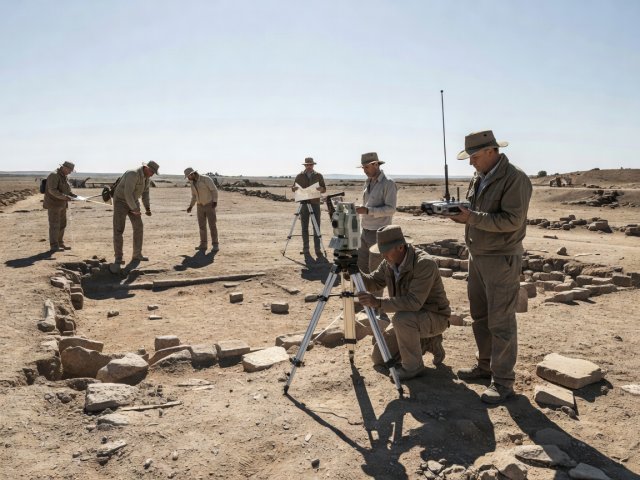
Survey team setting up a total station and GPS rover across an open archaeological terrace in clear daylight
Airborne remote sensing maps only surface relief; on-foot excavation and ceramic chronology remain essential to prove whether mounds were occupied simultaneously.
Remote Sensing & Ground-Truthing LiDAR & Magnetometry

Airborne LiDAR and Why Foot Survey Still Matters

Light Detection and Ranging (LiDAR) fires hundreds of thousands of laser pulses per second from a small aircraft or drone toward forested terrain. While most pulses bounce off upper leaves, a fraction pass through tiny canopy gaps, strike the forest floor, and return to the sensor. By subtracting vegetation returns, archaeologists generate a digital elevation model capable of spotting a 30-centimetre agricultural terrace ridge or sunken footpath beneath 40-metre rainforest trees.

Across the Guatemalan Petén (PACUNAM initiative, 2018), Angkor in Cambodia (Damian Evans et al.), and Amazonia, LiDAR transformed isolated temple ruins into vast hydraulic and agricultural suburbs. Yet field researchers stress an essential methodological caveat: LiDAR is chronologically blind. A bare-earth scan flattens a thousand years of construction onto a single screen. Only shovel test pits, ceramic seriation, and radiocarbon samples excavated on foot can distinguish a town occupied all at once from five smaller villages built side-by-side over eight centuries.

Imaging & Biomolecules

Reading Locked Texts and Microscopic Residues

Herculaneum & En-Gedi Phase-Contrast X-Ray CT

Virtual Unwrapping of Carbonised Scrolls

Excavated in the 1750s from a seaside villa in Herculaneum, over 800 papyrus scrolls were baked into fragile charcoal cylinders by pyroclastic surges. Because Roman scribes wrote chiefly with carbon soot ink on carbonised plant fibres, ordinary X-rays see almost zero density contrast. Computer scientist Brent Seales pioneered virtual segmentation of warped papyrus layers, and in 2023–2025, 8-micrometre synchrotron scans at Diamond Light Source paired with neural networks trained on subtle surface ink textures read hundreds of columns of Epicurean Greek philosophy without touching a single flake.

ZooMS & Organic Residue Mass Spectrometry

Proteomics & Ceramic Lipid Fingerprints

Unglazed earthenware pots absorb microscopic fats from whatever simmered inside them millennia ago. Gas chromatography–combustion–isotope ratio mass spectrometry (GC-C-IRMS) distinguishes ruminant dairy fats, beeswax, marine oils, and fermented cacao alkaloids (theobromine)—pushing documented cacao domestication back to ~3300 BCE at Santa Ana-La Florida in Ecuador. Similarly, peptide fingerprinting of bone collagen (ZooMS) screens thousands of tiny cave bone fragments to locate rare hominin remains such as Denisovan fossils.

Analytical Technique Sample Required Historical Question Answered Key Limitation
Bayesian Radiocarbon + Cosmic-Ray Miyake Events Charred short-lived seeds, twigs, or annual tree rings Pins construction or felling dates down to decades—or exact calendar years (e.g., Vikings at L'Anse aux Meadows in 1021 CE via the 993 CE solar spike) "Old wood effect" if heartwood from centuries-old beams is dated carelessly
Strontium & Oxygen Isotopes (87Sr/86Sr) Tooth enamel formed in childhood vs. rib bone remodelled in adulthood Reveals whether an individual grew up locally or migrated across distinct geological bedrock zones Multiple regions can share identical bedrock strontium signatures ("isotopic equifinality")
Experimental Archaeology Modern replicas of stone hammers, clay furnaces, and bronze saws Tests energy, person-hours, and microscopic wear patterns against surviving ancient tool marks Demonstrates a plausible method, not necessarily the single method used in antiquity

Read Excavation FAQ →